


Dental Inlays, Onlays and Overlays
Custom partial restorations (inlays, onlays or overlays) for back teeth damaged by decay or fractures.
What are dental inlays?
Dental inlays partially restore posterior teeth that have been affected by cavities or fractures.
It is a conservative treatment that in ancient times was done with gold, but was discontinued because this material was unaesthetic. Today they are back in vogue due to the existence of 3D technology that allows them to be made with very aesthetic and resistant materials.
It is a preparation widely used at ENIQ for being very conservative, in line with the new concepts of biomimetics and thanks to successful adhesive dentistry, we can currently always add never subtract, thanks to the development of materials and adhesive technique.

What are the advantages of dental inlays?
The interesting thing about this procedure is that WE ONLY ADD, we never subtract from the dental structure.
We place the lost structure of the tooth as if it were a lego piece.
Explanation of the digital capture process for dental inlay
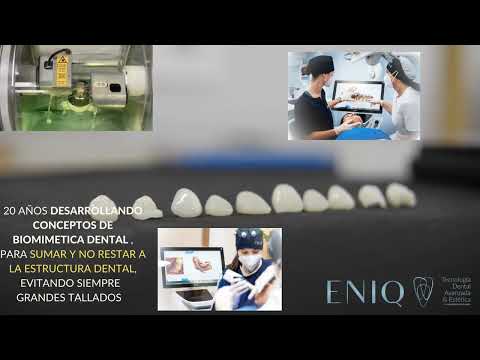
We digitally capture which is like taking photographs of the tooth in your mouth, then we design in our design software in about 15 minutes, while you have a coffee we mill in the most convenient material depending on the case (about 15 minutes) and then we cement it in your mouth with the best materials on the market and strict protocols.
When the damage is extensive, a full dental crown is the appropriate option. If the damage is minimal, an aesthetic dental reconstruction with resin is enough. If you are not sure which restoration you need, we explain the types of dental prosthesis according to how much tooth has been lost.
What are the types of dental inlays?
Modern dentistry offers advanced solutions to restore damaged teeth, such as dental inlays. These are classified into three types: Inlay, Onlay, and Overlay, each designed to adapt to different levels of dental damage. These conservative techniques allow restoring the integrity of the teeth with functional and aesthetic results.

Types
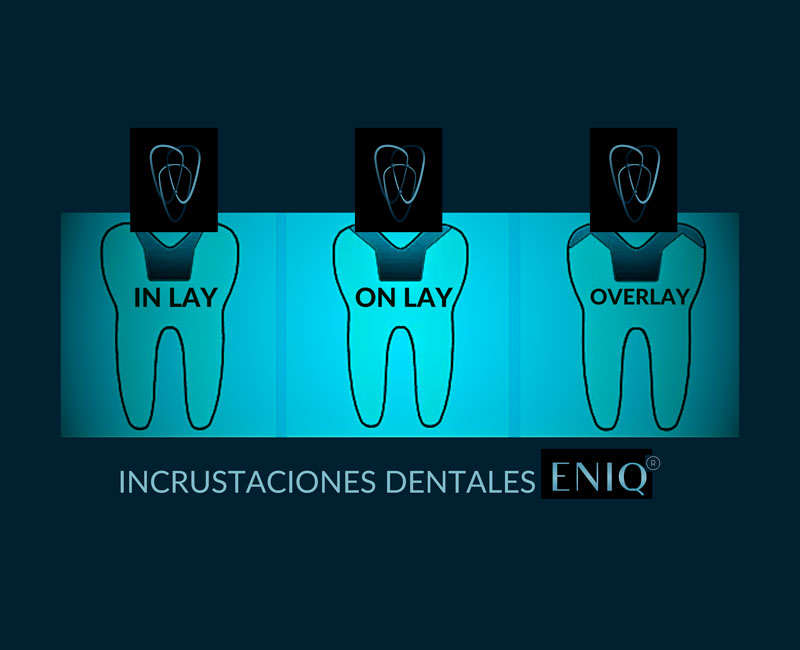
Inlay
It is the simplest, since the dental cusp does not need to be repaired. We refer to the tip or relief of the tooth crown.
Onlay
It is used to restore a cusp of the tooth that has become weak after removing the cavity or fracture.
Overlay
These are those made to cover all the cusps, giving them strength for chewing and preventing them from fracturing.
There are three different types of inlays, depending on how large the damage to the tooth is. Each type is designed to provide the most conservative and effective solution according to the specific case.

Exclusive Benefits of Dental Inlay at ENIQ
Opting for a dental inlay at ENIQ means benefiting from a combination of cutting-edge experience and commitment to dental excellence.
Experience and International Recognition
With more than 15 years at the forefront of technological innovation, ENIQ has been recognized internationally in 2021 and 2022 for its significant contribution to the development of digital workflows in dentistry.
- Cutting-edge 3D Technology: Our early adoption and refinement of 3D technology allows us to replicate the natural shape of your teeth with millimetric precision.
- Natural Restorations: We ensure restorations that not only look natural but also function in perfect harmony with the rest of your mouth.
Biomimetic Dentistry
Biomimetic Dentistry is not just a practice at ENIQ; it is a philosophy that guarantees responsible treatments that respect the integrity of your dental structure.
- Dental Preservation: We always add, never subtract dental structure, thanks to the development of advanced adhesive materials and technique.
- High Quality Materials: We use materials manufactured at high pressures that are extremely stable over time and highly aesthetic.
With ENIQ, your smile is not only restored to its ideal state but is preserved with the maximum quality and care you deserve.
What is the price of a dental inlay?
Dental Inlay
Complete solution
The price varies according to the size and material used. Overlay inlays are the most complete and conservative.
From €150 to €350 depending on size
High precision 3D technology
Aesthetic and resistant materials
Same-day procedure
All inclusive

Frequently asked questions about dental inlays
Get answers to your questions about dental inlays in Madrid. customer service.
At Clínica ENIQ, a dental inlay costs between €150 and €350, depending on its size and the material used. The most expensive are overlays, which cover all the cusps of the tooth and are practically conservative crowns. The final price is confirmed at your assessment with the specialist, and we offer financing without paperwork from €150 to €3,000.
They differ in how much of the tooth they rebuild. The inlay is the simplest, because no cusp needs to be repaired (the tip or raised part of the tooth crown). The onlay restores a cusp that has become weak after removing the decay or fracture. The overlay covers all the cusps to give the tooth strength for chewing and prevent it from fracturing. The type is chosen according to how large the damage is, always looking for the most conservative solution.
It is the most complete type of inlay: it covers all the cusps of the tooth to give it strength for chewing and prevent it from fracturing, which is why it is considered practically a conservative crown. Inlays are indicated when the damage to the tooth is moderate and the aim is to preserve as much healthy structure as possible; when the damage is extensive, a crown is recommended. Its price is at the top of the inlay price range, up to €350.
Yes, with our 3D technology the procedure is done on the same day. We capture the tooth digitally, which is like taking photographs of it in your mouth; we design the inlay in our software in about 15 minutes and mill it in the most suitable material for your case in roughly another 15 minutes. It is then cemented in your mouth. The whole treatment is carried out under local anaesthesia.
The dental inlay procedure is not painful. It is performed under local anesthesia, so you will not feel pain during the treatment. Tooth preparation is minimally invasive and conservative, which significantly reduces any discomfort. After the procedure, it is normal to experience slight temporary sensitivity, but this usually disappears within a few days. Most patients find the procedure very comfortable and any postoperative discomfort is minimal and easily manageable with over-the-counter pain relievers if necessary. At ENIQ, we use advanced techniques and state-of-the-art materials to ensure your maximum comfort throughout the process.
Dental inlays have an excellent life expectancy, lasting between 10 and 30 years or more with proper care. Durability depends on several factors: the quality of materials used, the precision of manufacturing (at ENIQ we use high-precision 3D technology), the cementation technique, and mainly, patient care. To maximize its durability, it is essential to maintain excellent oral hygiene with brushing three times a day and use of dental floss, make regular visits to the dentist for checkups and professional cleanings, avoid harmful habits such as biting hard objects or using teeth as tools, and if you have bruxism, use a night splint. The modern materials we use at ENIQ, manufactured at high pressures, are extremely stable over time and resistant.
Each one is used for a different situation. Crowns are recommended when there is large destruction of the dental piece, restorations when the destruction is minimal, and inlays when the destruction is medium and one wants to be very conservative. At ENIQ we love inlays because they preserve a lot of dental tissue, if used with 3D system they are very precise and with extremely stable materials over time since they come from blocks made at high pressures. The proper use of all three alternatives is part of the approach of responsible dentistry. It is important to request information about all the alternatives your dentist has. Unfortunately, the conflict of interest when health becomes a business means that on many occasions there is misuse of what is most convenient for the patient. There is an overdiagnosis of root canal, posts, and crowns trying to compensate for low price scales. That is why it is so important to educate patients so they are able to participate in the selection process of their treatments. We recommend getting informed, looking for qualified professionals, and not falling for misleading advertising.