

Ceramic and porcelain veneers in Madrid
Thin ceramic shells bonded to the front of the teeth to correct their color, shape or wear.
What is a dental veneer?
A dental veneer is a thin layer of material placed over the front surface of a tooth to improve its aesthetic appearance. Dental veneers can be made of different materials, such as porcelain, composite, or resin.
Dental veneers are a popular option to correct a variety of dental imperfections, such as:
Stains and discoloration
Veneers can cover persistent stains and discoloration that cannot be removed with conventional teeth whitening.
Tooth wear
If teeth are worn due to aging, habits like bruxism (teeth grinding), or excessive consumption of acidic foods and drinks, veneers can restore the appearance of the teeth and improve their function.
Fractures and chips
Veneers can cover small fractures or chips in teeth, providing a more uniform appearance and protecting the tooth from further damage.
Gaps between teeth
If there are excessive gaps between teeth, veneers can close those spaces and improve the appearance of the smile.
Misaligned or slightly crooked teeth
If teeth are slightly crooked or misaligned, veneers can create the appearance of straighter, more aligned teeth without the need for extensive orthodontic treatment.
The process of placing dental veneers generally involves several stages, including treatment evaluation and planning, tooth preparation, taking impressions, fabricating custom veneers in a dental laboratory, and finally placing the veneers on the teeth.
It's important to note that placing dental veneers is an irreversible procedure, as it generally involves removing a small amount of dental enamel to allow proper fit. Therefore, it's essential to discuss all options and considerations with a dentist before deciding whether dental veneers are the best option for your specific dental situation.
What types of veneers exist?
Several types of dental veneers are available, each with its own characteristics and advantages. The most common types are:
- Porcelain veneers: Natural appearance, durable, stain-resistant.
- Composite veneers: More affordable, repairable, less durable.
- Lithium disilicate: Very resistant and aesthetic.
- Reinforced ceramic: Greater resistance than conventional composite.
Each type of dental veneer has its own advantages and disadvantages. The most suitable choice depends on your individual needs and preferences, as well as your dentist's recommendations.
Why choose ENIQ?
Advanced technology and highest quality materials for natural, long-lasting results (typically 10-15 years with good maintenance).
If you prefer not to reduce the enamel, veneers without filing down the teeth (no-prep) are potentially reversible, although they allow more limited changes. Ceramic veneers can be part of a digital smile design, in which you see the result before starting. If the tooth is very weak or has extensive decay, a dental crown (cap) is usually more appropriate than a veneer.

How are ceramic veneers placed and how many visits does it take?
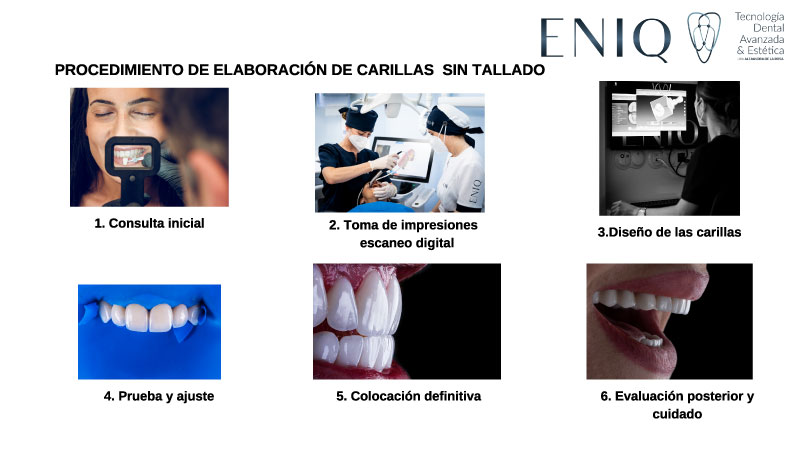
The number of appointments needed to place a dental veneer can vary depending on the specific case and dental practice. However, at least two appointments are generally required to complete the placement process.

Appointments needed
Initial consultation and preparation
At the first appointment, the dentist will evaluate your dental situation, discuss your aesthetic goals, and determine whether dental veneers are the right option for you. If you decide to proceed, the teeth are prepared by removing a thin layer of enamel to allow space for the veneers. Impressions are taken of the prepared teeth and the correct shade is selected. In some cases, a temporary veneer may be placed while the final veneers are fabricated in the dental laboratory.
Placement of the final veneers
At the second appointment, the final veneers are placed. The dentist verifies the fit, shape, and color of the veneers and makes any necessary adjustments. The veneers are then bonded to the teeth using a special dental adhesive, with a curing light to harden the bond and ensure a solid attachment.
A follow-up appointment may be required to check the fit of the veneers and make any final adjustments. Additional periodic check-ups can be scheduled to monitor tissue response and ensure the veneers remain in good condition over time.
The exact number of appointments may vary by case and by the dentist's preferences. More complex cases can require additional visits to achieve the best result. Your dentist will guide you through the process and tell you how many appointments your specific treatment will need.

Veneer comparison: Lithium disilicate vs. Porcelain
The choice between lithium disilicate and porcelain veneers depends on each patient's needs and the dentist's recommendation. Both offer distinct advantages:
- Lithium disilicate veneers: Offer translucency and a very natural look, reflecting light similarly to dental enamel. They are strong and durable, withstanding chewing forces well. They require less tooth reduction than other options, preserving more natural dental structure.
- Porcelain veneers: Provide a natural aesthetic and can replicate the gloss and translucency of dental enamel. They are durable and stain-resistant, with high resistance to abrasion and fractures. They allow detailed personalization of shape, size, and color for each patient.
Veneer comparison: Porcelain vs. Composite
The choice between porcelain and composite veneers also depends on the patient's needs and preferences:
- Porcelain veneers: Look highly natural and aesthetic, mimicking the translucency of dental enamel. They are durable, stain-resistant, with long lifespan and color stability.
- Composite veneers: Require less tooth preparation, preserving more tooth structure. They are easier to repair if damaged or worn. They are more affordable than porcelain veneers, which can be a decisive factor for some patients.
In summary, both lithium disilicate and porcelain veneers are excellent options and deliver high-quality aesthetic results. The choice depends on multiple factors, including the dentist's professional opinion and the patient's specific preferences and needs. Consultation with the dentist is crucial to determine the most suitable option for each individual case. Both options can deliver satisfactory aesthetic results, but the final decision should be based on professional evaluation and personal preferences.
What are the disadvantages of dental veneers?
While dental veneers are a popular option to improve the appearance of teeth, they also have some disadvantages or drawbacks to consider:
Irreversibility
Placing dental veneers usually involves removing a thin layer of enamel to allow proper fit. This process is irreversible — once the veneers are placed, the teeth will always require dental protection.
Dental sensitivity
Some patients may experience dental sensitivity after veneer placement. This can occur due to the removal of the thin layer of enamel and the exposure of the underlying dentin. Sensitivity is usually temporary and resolves quickly, but in some cases it may persist. If sensitivity is uncomfortable or persistent, it's important to inform your dentist so steps can be taken to relieve it.
Risk of fractures or damage
Dental veneers, especially porcelain ones, are durable and strong, but they can still fracture or be damaged. Avoiding biting hard objects and not using teeth as tools helps prevent potential problems.
Color changes
Although dental veneers are stain-resistant, color changes can occur over time due to natural aging, consuming pigmented foods and drinks, and smoking. If this happens, veneers may need to be replaced to maintain optimal aesthetics.
Care and maintenance requirements
To extend the life of dental veneers and preserve their appearance, good oral hygiene is required, along with following the dentist's recommendations. This includes brushing twice daily, flossing regularly, avoiding foods and drinks that may stain the veneers, and attending regular dental check-ups.
Cost
Dental veneers can have a significant cost, especially porcelain ones, since they are custom-made in a dental laboratory. Cost can vary depending on geographic location, the dentist, and the number of veneers needed.
It's important to discuss all these considerations with a dentist before deciding if dental veneers are the right option for you. The dentist will evaluate your dental situation, inform you about the advantages and disadvantages, and help you make an informed decision that meets your needs and expectations.
Dental veneer prices
Composite veneers: The most accessible option. They are made directly in the practice in a single session without an external laboratory, which is reflected in the final price.
Porcelain veneers: The usual range in Spain is €250 to €500 per piece (source: Consejo General de Dentistas de España). They are custom-made in a specialist dental laboratory, which accounts for the higher cost compared to composite.
Lithium disilicate veneers: A high-strength ceramic with excellent aesthetics. The manufacturing process is similar to conventional porcelain; the price reflects the premium material and minimal tooth preparation required.
The total treatment cost depends on the number of veneers required, which is determined through a personalised smile design assessment.
Dental veneers
Ceramic / porcelain
The indicative price for porcelain or ceramic veneers in Spain is between €250 and €500 per piece. The final price depends on the material, the number of pieces, and the complexity of each case.
Personalised smile design included
No-obligation assessment
High-quality ceramic materials
What the price includes
These items are part of the dental veneer treatment at our practice:
Digital smile design
Prior design using specialist software to visualise the expected result before treatment begins.
Assessment and treatment planning
Consultation with the dental aesthetics specialist to evaluate the tooth condition, determine the most suitable material, and plan the number of pieces.
Tooth preparation and impressions
Minimal enamel reduction (when necessary) and precise records for the custom fabrication of the veneers in the laboratory.
Veneer fabrication and placement
Custom-made in a specialist dental laboratory and bonded using high-strength dental adhesive.
Post-treatment review
A follow-up appointment to check the fit, occlusion, and tissue response.
Always review the detailed breakdown before signing any treatment plan to avoid surprises.
What may not be included
Some prior or complementary treatments may involve an additional cost:
Necessary prior treatments
Any active decay, periodontal disease, or other conditions must be treated before placing the veneers. These procedures are quoted separately.
Whitening of the remaining teeth
If you wish to match the shade of the remaining teeth to the veneer colour, whitening is quoted separately.
Extended provisional veneers
In cases requiring a longer provisional phase, temporary veneers may carry an additional cost.
Our team will provide a detailed, no-obligation quote after your initial assessment.
What factors affect the cost of dental veneers?
The final budget for a veneer treatment can vary considerably depending on several elements. Understanding them helps you make sense of differences between quotes.
Main cost variables
Veneer material
Composite is applied directly in the practice and is the most affordable option. Porcelain and lithium disilicate are fabricated in a laboratory and offer greater durability and aesthetics at a higher cost.
Number of pieces
The total price is multiplied by the number of veneers required. A full smile design covering several upper and lower teeth will cost more than correcting a single tooth.
Case complexity and tooth preparation
If the tooth requires more enamel reduction, prior decay treatment, or pre-existing restorations, the procedure is more involved and may be reflected in the quote.
Dental laboratory
The quality and specialisation of the laboratory fabricating the veneers affects both the aesthetic outcome and the cost. Highly specialised dental ceramic laboratories use materials and techniques that ensure greater precision.
Necessary prior treatments
Active decay, periodontal problems, or other conditions must be resolved before placing the veneers. The cost of these prior treatments adds to the total budget.
The only way to obtain an accurate quote is through a personalised assessment. At ENIQ we offer an initial study with no obligation.
Can dental veneers be financed?
We understand that the cost of a veneer treatment can be a significant investment. That is why at ENIQ we offer a documentation-free financing option to make treatment more accessible.
Documentation-free financing
We offer financing without the need to provide additional documentation, for amounts ranging from €150 to €3,000. The process is straightforward and managed directly at the practice.
- Financeable amounts: From €150 to €3,000, covering single-veneer treatments as well as multi-tooth cases.
- No paperwork required: No external documentation is needed. The process is handled simply and directly at the practice.
- No-obligation quote: Before starting any treatment, you will receive a detailed quote following your specialist assessment, with no commitment required.
Contact us to find out about the financing conditions available at the time of your consultation.

Frequently asked questions about ceramic veneers
Get answers about pricing, financing, procedure, and candidacy for dental veneers in Madrid. customer service.
The indicative price for porcelain or ceramic veneers in Spain is between €250 and €500 per piece, according to the Consejo General de Dentistas de España. The total price depends on the material chosen, the number of pieces, and the complexity of the case. Composite veneers are more affordable as they are completed in a single in-practice session. At ENIQ we offer a no-obligation quote following your initial assessment.
Practically yes: porcelain is a dental ceramic, which is why people speak of ceramic or porcelain veneers. They are custom-made in a dental laboratory, are very thin, are bonded to the front of the tooth and resist staining well. Another widely used ceramic is lithium disilicate, thinner and stronger than conventional porcelain, which is used especially when minimal tooth preparation is the goal.
Ceramic or porcelain veneers look very natural, mimic the translucency of enamel, resist staining better and last longer, typically 10 to 15 years with good maintenance. Composite veneers are made directly at the clinic in a single session, need less tooth preparation, are easy to repair and are more affordable, but they require more maintenance and usually do not last as long. At the assessment we help you choose based on your case and your budget.
Traditional ceramic veneers require removing a thin layer of enamel. This allows greater correction of the shape, size and position of the teeth, with very predictable results, but the treatment is irreversible. No-prep veneers are bonded to the enamel without grinding it, or with minimal grinding, and are potentially reversible, although they allow more limited changes and may not hide severe stains or irregularities. Which one suits you depends on your case, and we assess it with you.
Dental veneers can last between 10 and 15 years with proper care. Durability depends on the material used, oral hygiene habits, and the care given. Porcelain veneers tend to be more durable than composite ones.
The veneer placement procedure is generally not painful. Local anaesthesia is used during tooth preparation to ensure patient comfort. After treatment, there may be slight temporary sensitivity that resolves within a few days.
Generally 2-3 appointments are needed. The first for evaluation and planning, the second to prepare the teeth and take impressions, and the third to place the final veneers. An additional appointment for final adjustments may occasionally be required.
Veneers are suitable for patients with resistant stains, mild wear, small fractures, diastemas, or minor shape irregularities in the front teeth, provided periodontal health and occlusion are correct. They are not indicated where there is active decay, untreated periodontal disease, severe uncontrolled bruxism, or insufficient dental structure. The specialist assessment determines suitability in each case.
No, placing porcelain and lithium disilicate veneers is an irreversible procedure because a small amount of dental enamel must be removed to allow a proper fit. Once placed, the tooth will always require dental protection. Composite veneers with minimal or no preparation have less impact, but the specialist will assess each case individually.
Yes, you can eat normally with dental veneers. However, it is advisable to avoid biting hard objects such as ice or very hard nuts, and not to use your teeth as tools. It is also recommended to limit foods and drinks that may cause staining.
Veneer maintenance is straightforward: gentle brushing at least twice a day, use of dental floss or interdental brushes, avoiding biting hard objects or using teeth as tools, and attending regular check-ups. In cases of bruxism, a night-time occlusal splint is recommended to protect the veneers.
The choice between a dental veneer and a dental crown depends on several factors, including tooth condition, treatment goal, and the dentist's recommendation. Dental veneers are suitable for aesthetic improvement and preserving dental structure — ideal for correcting stains, discolouration, small fractures, and gaps between teeth. Dental crowns are more appropriate for restoring weakened teeth or teeth with large fillings or extensive decay. In summary, veneers are better suited for improving aesthetics, while crowns are used to restore damaged or weakened teeth.
Yes. At ENIQ we offer documentation-free financing for amounts between €150 and €3,000. The process is handled directly at the practice in a straightforward manner. You can request it at the time of your quote.
Clínica ENIQ is located at C. de Hermosilla, 78, in the Barrio de Salamanca neighbourhood of Madrid, just a few minutes from Goya metro station (lines 2 and 4). You can contact us by phone or through our website to request a no-obligation initial assessment.