

Dental Prosthetics in Barrio de Salamanca, Madrid
Crowns, inlays and fixed or removable prostheses to restore damaged teeth or replace missing ones.
What is a dental prosthesis?
A dental prosthesis is an artificial device designed to replace one or more missing teeth. These prostheses are essential for restoring chewing function, improving aesthetics and pronunciation, and maintaining the structural integrity of the mouth and face.
A short walk from Goya metro, on C. de Hermosilla, 78, Dr. Alejandra de la Rosa designs the prosthesis that best fits your case. We restore a single tooth with ceramic or zirconia crowns and inlays that preserve as much healthy enamel as possible; and when several teeth are missing, we plan a fixed prosthesis for a permanent solution or a removable prosthesis that is easy to take out and clean. We take digital impressions for a precise fit and care for patients from Recoletos and Goya who want to regain their bite and smile close to home.
What are dental prostheses used for?
Dental prostheses are used to replace lost or damaged teeth. They have several purposes:
Functionality
They improve chewing and speech, which can be affected by missing teeth.
Aesthetics
They restore the appearance of the smile, which is important for self-esteem and social interaction.
Dental Health
They help maintain proper alignment of remaining teeth, preventing displacement and other dental problems.
Structural Support
In some cases, prostheses can provide support to facial muscles, preventing the sunken appearance that can occur with tooth loss.
In summary, dental prostheses not only improve appearance but also contribute significantly to oral health and functionality.
What are the advantages of placing a dental prosthesis?
Dental prostheses offer several important advantages:
Improved Chewing Function
They allow more effective chewing, which is essential for good digestion and nutrition.
Improved diction and speech
Tooth loss can affect the way of speaking. Prostheses help restore clear pronunciation.
Aesthetics and Self-Confidence
They improve the appearance of the smile and facial aesthetics, which in turn can increase self-esteem and emotional well-being.
Prevention of Future Dental Problems
By replacing missing teeth, prostheses help prevent adjacent teeth from moving or shifting, preventing future dental problems.
Structural Support
They provide support to facial muscles, preventing the facial sinking that can occur with tooth loss.
Durability and Efficiency
Modern prostheses are durable and efficient, with materials that mimic the appearance of natural teeth.
Adaptability and Variety
There are different types of prostheses to adapt to various needs and situations, from partial to complete prostheses, fixed or removable.
Improved Overall Health
By improving chewing and nutrition, prostheses can contribute to better overall health.
Together, these advantages make dental prostheses a valuable solution for those who have lost one or more teeth.
When a tooth is badly damaged, we restore it with ceramic or zirconia dental crowns or caps. If the damage is moderate, a partial restoration such as a dental overlay preserves as much healthy tooth as possible. If teeth are missing, a dental bridge attached to the neighboring teeth fills the gap and you do not have to take it out. A removable denture, partial or complete, is taken out for cleaning.

Prosthetics Treatments
Dental Crown
Cap that fully covers a badly weakened tooth, for example after extensive decay, so that it does not break when chewing.
Dental Inlays
Custom partial restorations (inlays, onlays or overlays) for back teeth damaged by decay or fractures.
Fixed Prosthesis
Dental bridge permanently fixed to the neighboring teeth to replace one or more missing teeth.
Removable Prosthesis
Partial or complete denture that the patient can take out and put back in, held by metal or aesthetic clasps or other attachments.
Swipe to see more treatments
ENIQ's 3D digital laboratory: complete CAD-CAM workflow
In 2021 ENIQ received the Dentsply Sirona Smart Integration award as the first dental centre in Spain to integrate a complete digital workflow. Every prosthesis we design follows an entirely digital process — from intraoral scanning to milling in our in-house CAD-CAM laboratory — with no intermediaries and no loss of precision.

Innovation
Intraoral scanning and CAD-CAM design
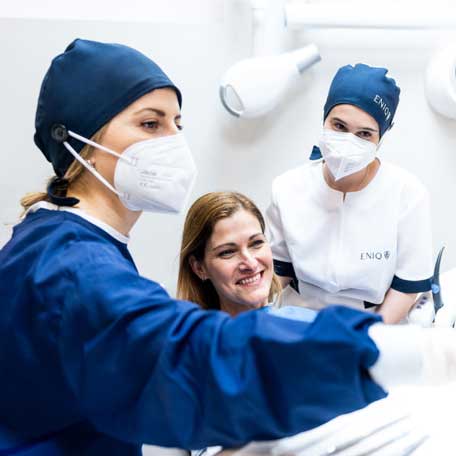
We capture a digital impression of your mouth using an intraoral scanner — no impression paste or uncomfortable trays required. The data is transferred directly to CAD-CAM software, where Dr. Alejandra de la Rosa designs your restoration to sub-millimetre precision before sending it to the milling unit.
In-house 3D digital laboratory
The restoration is milled in our own digital laboratory from high-density ceramic or zirconia blocks. Because we do not outsource fabrication, we oversee every stage of the process, allowing same-visit adjustments and reducing the number of appointments needed.
ENIQ's complete digital workflow — recognised with the Dentsply Sirona Smart Integration Award 2021 — ensures that every prosthesis is produced with consistent precision and traceability from the first scan to final placement.

Frequently asked questions about dental prosthetics
Get answers to your questions about our dental prosthetic treatments in Madrid. customer service.
It depends on how much of the tooth has been lost. If a tooth is damaged but keeps part of its structure, it is restored with an inlay (when the damage is moderate and a very conservative approach is wanted) or with a ceramic or zirconia crown or cap (when the damage is extensive). If teeth are missing, they are replaced with a fixed prosthesis, such as a bridge attached to the neighbouring teeth that the patient cannot remove, or with a removable prosthesis, partial or full (dentures), which is taken out for cleaning. Prostheses can also be placed on implants. At your first visit we assess your case and explain which option suits you best.
It depends on the type of prosthesis, the material and each case. As a guide, at Clínica ENIQ an inlay costs between €150 and €350; a porcelain crown or cap from €350, and a zirconia one from €400; a three-unit fixed dental bridge between €900 and €1,400 (four units, between €1,100 and €1,600); and a partial removable denture between €500 and €600, or a full one between approximately €600 and €1,000. These are approximate prices: we give you an exact, no-obligation quote after a first assessment. We offer financing without paperwork from €150 to €3,000, so you can spread the cost at your own pace without complicated procedures.
It depends on the type of prosthesis. Crowns, inlays and other fixed restorations follow a fully digital workflow: we take a digital impression of your mouth with an intraoral scanner, with no impression paste or moulds; Dr. Alejandra de la Rosa designs the restoration with CAD-CAM software and it is milled in our own digital laboratory from high-density ceramic or zirconia blocks, which allows adjustments in the same appointment and reduces the number of visits. Removable prostheses are made from impressions and bite records, with an acrylic base that mimics the gums and artificial teeth made of resin or porcelain.
The duration of a dental prosthesis depends on several factors, including the type of prosthesis, the materials used, the care and maintenance it receives, and the patient's habits. In general, fixed prostheses such as crowns and bridges can last between 10 and 15 years or more with proper care. Removable prostheses usually have a useful life of 5 to 10 years, although they may need periodic adjustments or relines. Dental implants, which serve as a base for fixed prostheses, can last a lifetime if properly maintained. It is important to make regular visits to the dentist for checkups and maintenance, which can significantly extend the useful life of any dental prosthesis.
Yes, dental prostheses can significantly improve aesthetic appearance. They are designed to mimic the natural appearance of teeth and gums, restoring the smile and facial structure. Modern prostheses use advanced materials such as ceramic and zirconium that replicate the color, translucency, and texture of natural teeth. In addition to replacing missing teeth, prostheses can correct aesthetic problems such as discolored, worn, or misaligned teeth. They also help maintain facial shape by providing support to facial muscles, preventing the sunken appearance that can occur with tooth loss. The result is a more attractive and natural smile that can significantly increase the patient's self-esteem and confidence.
Dental prostheses can be both permanent and temporary, depending on the type and purpose. Permanent or fixed prostheses include crowns, bridges, and dental implants that are cemented or screwed into place and cannot be removed by the patient. These are designed to be long-term solutions. On the other hand, removable prostheses, such as partial or complete dentures, can be removed by the patient for cleaning and maintenance. Temporary prostheses are usually used during transition periods, such as while waiting for healing after an extraction or the fabrication of a permanent prosthesis. The choice between permanent or removable prostheses depends on several factors, including the patient's oral health, the number of teeth to be replaced, aesthetic considerations, and budget.
Our clinic is located at C. de Hermosilla, 78 in the Barrio de Salamanca, Madrid, just a short walk from Goya metro station (lines L2 and L4) and served by bus lines 21, 53, 1, and 74. You can request your first appointment via the website form, by phone, or at the reception desk. At that initial visit we assess your case and explain your treatment options with no commitment required.
The time varies depending on the type of prosthesis. A crown or bridge on natural teeth is usually completed in two or three appointments over two to three weeks, whereas prostheses on implants require waiting for osseointegration of the implant, a process that can take several months. In each case we plan the treatment in advance and inform you of the estimated schedule from the very first visit.
Tooth preparation for a crown and impression-taking are carried out under local anaesthesia, so you should not feel pain during the procedure. After fitting it is normal to experience some sensitivity or mild discomfort for a few days, particularly when biting or with hot or cold foods. If the discomfort persists or is intense, we recommend contacting the clinic so our team can assess it and make any necessary adjustments.
Maintenance depends on the type of prosthesis: fixed ones (crowns, bridges) are cleaned with a toothbrush, fluoride toothpaste, and special dental floss for hard-to-reach areas. Removable prostheses should be taken out for cleaning with water and a specific prosthesis brush, avoiding strong abrasives. In both cases, regular clinic check-ups allow wear or misfit to be detected early, helping to extend the prosthesis's lifespan and maintain the health of the rest of your mouth.