


Conscious sedation dentistry: no more fear of the dentist
Inhaled nitrous oxide sedation to stay relaxed and awake during treatment, indicated for dental fear or anxiety.
What is conscious sedation in a dental clinic?
Conscious sedation is a procedure that consists of administering a series of sedative medications to a patient, with the aim of helping them relax and avoid the anxiety caused by dental treatment.
Nitrous oxide, at a concentration of 50% in the inspired fraction, has an analgesic effect with decreased threshold of perception of different painful stimuli.
At this concentration, nitrous oxide has no anesthetic effect. It produces a state of conscious sedation: the patient is relaxed, calm, and maintains a detached attitude from their environment.
Both the absorption and elimination of nitrous oxide through the pulmonary route are very rapid due to its low solubility in blood and tissues. This property explains the rapidity of its analgesic effect and the restoration of the initial state after cessation of inhalation.
Its elimination takes place unchanged through the pulmonary route.
At ENIQ we also administer an analgesic with sedation so that the post-operative period is more pleasant. With advanced AirLiquide technology.
AirLiquide HEALTHCARE sedation technology
However, it should be noted that conscious sedation does not serve to relieve pain. Therefore, when treatment is performed under sedation, anesthetic medication must also be used, which is what prevents pain and discomfort from the intervention.
How is conscious sedation performed?

The procedure is simple and safe. The patient inhales a mixture of nitrous oxide and oxygen through a nasal mask. The effect is immediate and is maintained throughout the treatment. Once finished, pure oxygen is administered for a few minutes and the patient fully recovers their normal state.
Because sedation does not remove pain on its own, it is combined with local anesthesia; if the injection worries you, our pain-free dentistry uses digital anesthesia. If you are having an implant, you can combine sedation with our ZenImplant™ implants, without cuts or stitches. It is also used to reduce anxiety during procedures such as wisdom teeth removal.

Advantages of conscious sedation
Conscious sedation is indicated in different cases. The most common is to use it when the patient is afraid or panicked about the dentist. Or also, when they have had previous bad experiences, which causes them nervousness or anxiety.
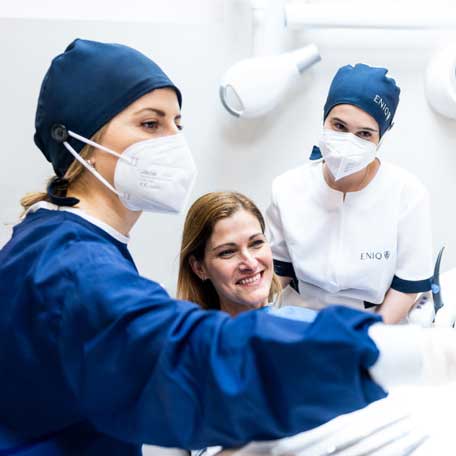

What are the advantages of conscious sedation?
Lack of time
Allows extensive treatments to be performed in a single session, optimizing patient time and reducing the number of visits needed.
Extensive treatment
Ideal for procedures that require several hours, allowing the patient to remain relaxed and comfortable throughout the treatment.
Complex treatment or long surgeries
Especially beneficial in implantology, complex surgeries, or treatments that require precision and time, keeping the patient calm.
Discomfort with dental treatments
Perfect solution for patients with pronounced gag reflex or who experience discomfort during dental treatments.
Compromised health
For patients with medical conditions that require special control, conscious sedation allows constant monitoring by the anesthesiologist.
Conscious sedation at ENIQ transforms the dental experience, eliminating fear and anxiety, allowing more efficient and comfortable treatments for the patient.
How much does conscious sedation cost?
Conscious sedation
Don't have a hard time at the dentist
Conscious sedation with AirLiquide HEALTHCARE technology. Accessible price €150-180 (other clinics €900-1000). Includes evaluation, administration, post-operative analgesic, and monitoring.
AirLiquide technology
Painkiller included

Frequently asked questions about conscious sedation
Answers to common questions about conscious sedation dentistry in Madrid. customer service.
At Clínica ENIQ, conscious sedation costs from €150. It includes the assessment, administration, a painkiller for recovery and monitoring during treatment.
No. With conscious sedation, which at ENIQ uses a mix of nitrous oxide and oxygen breathed through a nasal mask, you are relaxed but awake, and the effect wears off a few minutes after finishing. General anaesthesia makes you unconscious. Sedation does not remove pain on its own, so it is combined with local anaesthetic.
Yes, that is its most common use: it is indicated for patients who are afraid of or panic at the dentist, have had bad experiences or have a strong gag reflex. It also allows long treatments to be done in a single session while relaxed.
With conscious sedation, the patient is relaxed, calm, and maintains a detached attitude from their environment. A state of maximum relaxation is reached that is maintained throughout the procedure, providing a great sense of well-being. Nitrous oxide produces an analgesic effect that decreases the threshold of perception of different painful stimuli, although it has no anesthetic effect, so it is combined with local anesthesia.
The main contraindications include: pregnancy (especially first trimester), severe uncontrolled respiratory diseases, severe nasal obstruction that prevents breathing through the nose, patients with vitamin B12 deficiency, and certain neurological conditions. It is essential to perform a complete medical evaluation before the procedure to determine if conscious sedation is appropriate for each patient.
The complication rate derived from sedation is extremely low. Thousands of patients undergo surgical, dental, and/or medical procedures under sedation every day in all hospitals and medical centers worldwide. Conscious sedation with nitrous oxide is especially safe due to its rapid pulmonary absorption and elimination, which allows precise control of the sedation level and rapid restoration of the initial state.
Yes, one of the advantages of nitrous oxide is its rapid elimination from the body. Both absorption and pulmonary elimination are very rapid due to its low solubility in blood and tissues. A few minutes after waking up, you can leave the clinic and carry out your normal activities, including driving. This is a big difference from other types of deeper sedation.