


No-prep veneers in Madrid
Very thin veneers bonded directly to the tooth, without grinding it down or changing its shape.
What are no-prep veneers?
No-prep veneers, also known as non-prep veneers or veneers without preparation, are a type of dental veneer placed over the teeth without the need for significant grinding or reduction of the natural tooth structure. Unlike traditional veneers, which require removing a layer of enamel to make room for the veneers, no-prep veneers are bonded directly to the tooth surface without changing its shape or size.
No-prep veneers are generally thinner than traditional veneers, which allows them to be bonded directly to the existing enamel. They are made of materials such as composite or ultra-thin ceramic, which provide a natural, aesthetic appearance.
Preservation of natural tooth structure
Because no significant tooth reduction is required, more natural enamel is preserved compared with traditional veneers.
Faster, less invasive process
Placing no-prep veneers is a faster and less invasive process.
Reversibility
Because the tooth is not permanently reduced, no-prep veneers are potentially reversible.
However, bear in mind that no-prep veneers are not suitable for every case and may be less appropriate in certain situations. As always, it is advisable to consult a qualified, experienced dentist to determine whether no-prep veneers are the right option for your specific dental situation.
Why choose ENIQ for your no-prep veneers?
At ENIQ we use the most advanced technology and top-quality materials to deliver outstanding, natural results with no-prep veneers. Our team of cosmetic dentistry specialists tailors every treatment to each patient's specific needs, ensuring a comfortable experience and results that transform your smile while preserving as much of your natural tooth structure as possible.
When significant stains or irregularities need to be hidden, traditional ceramic veneers may be a better option. If it is the position of your teeth that needs correcting, the alternative is orthodontics. They can be combined with whitening or gum contouring within a smile design plan tailored to you.

How are no-prep veneers made?
Making no-prep (non-prep) veneers usually involves the following steps:
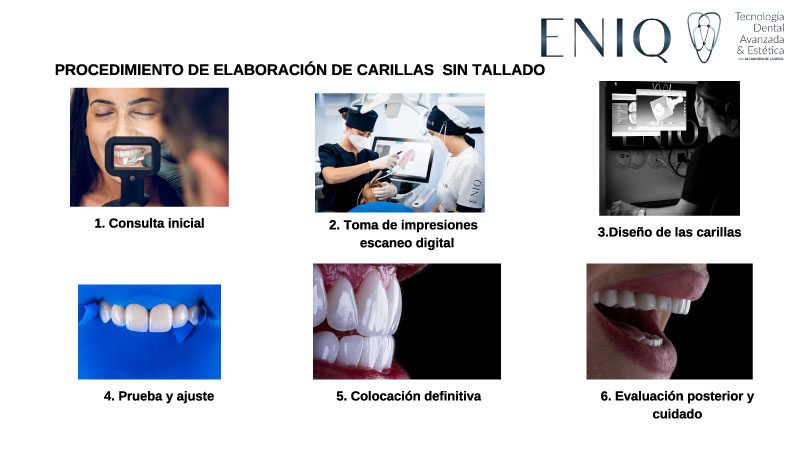

Steps of the procedure
Initial consultation
The process begins with an initial consultation with your dentist. During this visit you will talk about your aesthetic goals and your oral health will be assessed to determine whether you are a good candidate for no-prep veneers.
Impressions or digital scan
If you are found to be a good candidate, impressions of your teeth will be taken or a digital scan of your mouth will be made. This is used to create a three-dimensional model of your teeth, which serves as the reference for making the veneers.
Veneer design
Using the model of your teeth, the veneers are designed. This can be done by hand or with computer-aided design (CAD) technology to achieve optimal precision in the shape and size of the veneers.
Veneer fabrication
Once the design is finalised, the veneers are made from the selected material, either composite or ceramic. The fabrication process may vary depending on the type of veneer and the dental laboratory used. In some cases, computer-controlled milling machines (CAD) are used to shape the veneers precisely.
Try-in and adjustment
Once the veneers are made, an appointment is scheduled for the try-in and adjustment. During this visit your dentist will place the veneers on your teeth temporarily to check the fit, shape and colour. Minor adjustments can be made at the clinic to ensure an aesthetic and comfortable result.
Final placement
After the try-in and adjustment, the veneers are permanently placed on your teeth. Before placement, your teeth are cleaned and prepared to ensure the veneers bond properly. Special dental adhesives are used and a curing light is applied to harden the material and fix the veneers in place.
Follow-up and care
After placement, your dentist will check the result again and give you instructions on how to look after your veneers properly. It is important to follow oral care recommendations, such as brushing and flossing regularly, and to attend regular dental check-ups.
Please note that the specific process may vary depending on each case and the dentist's preferences. Talk to your dentist for precise, detailed information about how no-prep veneers would be made in your specific case.

How many visits does it take to place no-prep veneers?
Placing no-prep veneers generally requires fewer appointments than traditional veneers with tooth preparation. The exact number of appointments may vary depending on the individual case and specific circumstances, but in general the process of placing no-prep veneers involves around 2 to 3 appointments.
- Initial consultation: At this first appointment you will meet your dentist to discuss your aesthetic goals, assess your oral health and determine whether you are a suitable candidate for no-prep veneers. Impressions or a digital scan of your teeth may also be taken at this visit to create a three-dimensional model of your mouth.
- Try-in and adjustment: At the next appointment your dentist will place the no-prep veneers on your teeth temporarily to check the fit, shape and colour. Minor adjustments can be made at the clinic to achieve the desired aesthetic result. This stage is essential to ensure the veneers fit your teeth correctly and achieve the look you want.
- Final placement: At the last appointment the no-prep veneers are permanently placed on your teeth. Before placement, your teeth are cleaned and properly prepared to ensure good adhesion. Special dental adhesives are used and a curing light is applied to harden the material and fix the veneers in place.
Which is better: veneers with or without tooth preparation?
The choice between veneers with preparation and no-prep veneers depends on several factors, including your individual needs and preferences as well as your dentist's recommendations. Both approaches have their own advantages and considerations:
- Veneers with tooth preparation: Flexibility of correction: veneers with tooth preparation allow greater flexibility in the aesthetic correction of the teeth. By removing a thin layer of enamel, the shape, size and position of the teeth can be adjusted more significantly, allowing a personalised aesthetic result. Predictable results: because of the greater degree of control in preparing the teeth, veneers with tooth preparation deliver more predictable results in terms of appearance, aesthetics and dental alignment.
- No-prep veneers: Preservation of natural tooth structure: no-prep veneers require minimal or no removal of natural enamel, which preserves the original tooth structure. This can be especially beneficial for patients with healthy teeth who want a less invasive option. Faster, less invasive process: because no tooth preparation is required, placing no-prep veneers is faster and less invasive. This can make the experience more comfortable and reduce the risk of post-operative tooth sensitivity.
Bear in mind that the choice between prepared and no-prep veneers depends on your specific dental needs as well as your dentist's assessment and recommendation. It is advisable to discuss your goals, concerns and expectations with your dentist so you can make an informed decision and determine which option is best for your individual case.
What are the disadvantages of no-prep veneers?
Although no-prep veneers can offer certain advantages, they also have some disadvantages that are important to consider:
Limited thickness
No-prep veneers are usually thinner than traditional veneers, which means there is a limit to how much aesthetic correction can be achieved. In some cases it can be difficult to hide severe stains, discolouration or irregularities with no-prep veneers.
Limits on changing shape and size
Because no-prep veneers do not involve significant tooth reduction, they do not allow major changes to the shape and size of the teeth. If a more pronounced correction is needed, other options such as traditional veneers or orthodontic treatment may need to be considered.
Higher risk of an artificial look
Because of their limited thickness, it can be harder to achieve a completely natural, translucent look with no-prep veneers than with traditional veneers. In some cases no-prep veneers can look more opaque or less aesthetic.
Tooth sensitivity
Because there is no prior tooth preparation, some patients may experience greater tooth sensitivity after no-prep veneers are placed. This is because the enamel layer remains intact and there may be less protection against external stimuli.
Limited reversibility
Although no-prep veneers are considered potentially reversible, in some cases it can be difficult to remove them without damaging or wearing the enamel. It is therefore worth bearing in mind that reversing the treatment may not be as simple as with traditional veneers.
Please note that these disadvantages may vary depending on the individual case and the specific characteristics of the teeth and oral health. It is important to discuss your concerns and expectations with your dentist to determine whether no-prep veneers are right for you or whether other alternatives should be considered.
No-prep veneer prices
No-prep veneers
Price per tooth
The price of veneers varies with the number of veneers needed and other factors, with €250 to €500 per tooth being a good starting point.
All-inclusive

Frequently asked questions about no-prep veneers
Answers to your questions about no-prep veneers in Madrid. customer service.
As a guide, no-prep veneers cost between €250 and €500 per tooth. The final price depends on the material and the number of veneers you need, and it is calculated with a detailed study of your case using design software. We confirm it at your assessment.
Yes. They are different names for veneers placed without cutting or grinding the tooth, or with minimal grinding: they are also called non-prep veneers or veneers without preparation. They are thinner than traditional veneers, are bonded directly to the enamel and can be made of composite or ultra-thin ceramic.
They are potentially reversible: because the tooth is not permanently reduced, they can be removed or replaced in the future if necessary. Even so, in some cases it can be difficult to remove them without damaging or wearing the enamel, so it is worth discussing this with the dentist beforehand.
Because they are thinner than traditional veneers, they have limits: it can be difficult to hide severe stains, discolouration or irregularities with them, and they do not allow major changes to the shape or size of the teeth. In those cases traditional veneers or orthodontics may be a better option. At the assessment we check whether you are a good candidate.
Two or three appointments are usually enough, fewer than with traditional veneers: an initial consultation, where we assess your case and take impressions or a digital scan of your teeth; a try-in to check the fit, shape and colour; and the final placement. Some cases may need an additional appointment.
Because the tooth is not reduced, or only minimally, placement is faster and less invasive than with traditional veneers, which usually makes it more comfortable. Before placement, the teeth are simply cleaned and prepared so the veneers bond properly. Some patients notice tooth sensitivity after placement; if it bothers you or does not go away, tell your dentist.
Dental veneers can last between 10 and 15 years with proper care. Their durability depends on the material used, oral hygiene habits and the care they receive. Porcelain veneers tend to last longer than composite veneers.
Yes, you can eat normally with dental veneers. However, you should avoid biting hard objects such as ice or very hard nuts, and avoid using your teeth as tools. It is also advisable to limit foods and drinks that can stain.
The choice between a dental veneer and a dental crown depends on several factors, including the condition of the teeth, the goal of the treatment and the dentist's recommendations. Dental veneers are suited to aesthetic improvement and preserving tooth structure, making them ideal for correcting stains, discolouration, small fractures and gaps between teeth. Dental crowns are more appropriate for restoring weakened teeth, teeth with large fillings or extensive decay. In short, veneers are better suited to improving appearance, while crowns are used to restore damaged or weakened teeth.