


How to remove stains from your teeth
Treatment of tooth stains depending on their cause, with professional cleaning, whitening, veneers or restorations.
What are tooth stains?
Tooth stains are changes in colour on the surface of the teeth that can vary in appearance and severity. They can appear as brown, yellow, black, white or other abnormal shades on the teeth.
Tooth stains can be caused by a variety of factors, including:
Extrinsic staining
This occurs when colour particles are deposited on the outer surface of the tooth enamel. It can be caused by certain foods and drinks, such as coffee, tea, red wine and foods with artificial colourings, as well as by smoking or chewing tobacco.
Intrinsic staining
These are stains that originate inside the tooth. They can be caused by genetic factors, exposure to certain medicines while the teeth are developing, trauma or injury to the teeth, excess fluoride while the teeth are forming, or dental infections.
Plaque and tartar
A build-up of bacterial plaque on the teeth can cause stains and discolouration. If plaque is not removed properly, it can harden into tartar, which can also contribute to staining.
It is important to note that tooth stains vary in severity: in some cases they are superficial and easy to remove with a professional dental cleaning. In other cases, however, they may require more intensive treatments such as teeth whitening, veneers or restorative treatment, depending on the cause and extent of the stains.
It is advisable to see a dentist to assess the stains and decide on the best treatment approach in each case.
Dental veneers: a solution for stains and other imperfections
Dental veneers are a popular option for correcting a variety of dental imperfections, such as:
- Stains and discolouration: Veneers can cover persistent stains and discolouration that cannot be removed with conventional teeth whitening.
- Tooth wear: If the teeth are worn due to ageing, habits such as bruxism (teeth grinding) or excessive consumption of acidic foods and drinks, veneers can restore the appearance of the teeth and improve their function.
- Fractures and chips: Veneers can cover small fractures or chips in the teeth, giving a more even appearance and protecting the tooth from further damage.
- Gaps between teeth: If there are excessive gaps between the teeth, veneers can close them and improve the appearance of the smile.
- Misaligned or slightly crooked teeth: If the teeth are slightly crooked or misaligned, veneers can make them look straighter and more aligned without the need for extensive orthodontic treatment.
It is important to note that placing dental veneers is an irreversible procedure, as it usually involves removing a small amount of tooth enamel to allow a proper fit. It is therefore essential to discuss all the options and considerations with a dentist before deciding whether veneers are the best option for your specific dental situation.
Why choose ENIQ for tooth stain treatment?
At ENIQ we use the most advanced technology and top-quality materials to deliver outstanding, natural results. Our team of cosmetic dentistry specialists tailors every treatment to each patient's specific needs, ensuring a comfortable experience and results that transform your smile.
Surface stains, such as those from coffee, tea or tobacco, are usually removed with a professional cleaning or tooth whitening. Internal stains that do not respond to whitening can be covered with ceramic dental veneers. In children, white spots can be an early sign of demineralization that the CAMBRA protocol helps detect and treat in time.

What is the procedure for removing tooth stains?
The procedure for removing tooth stains can vary depending on the type and severity of the stains. These are the most common methods:
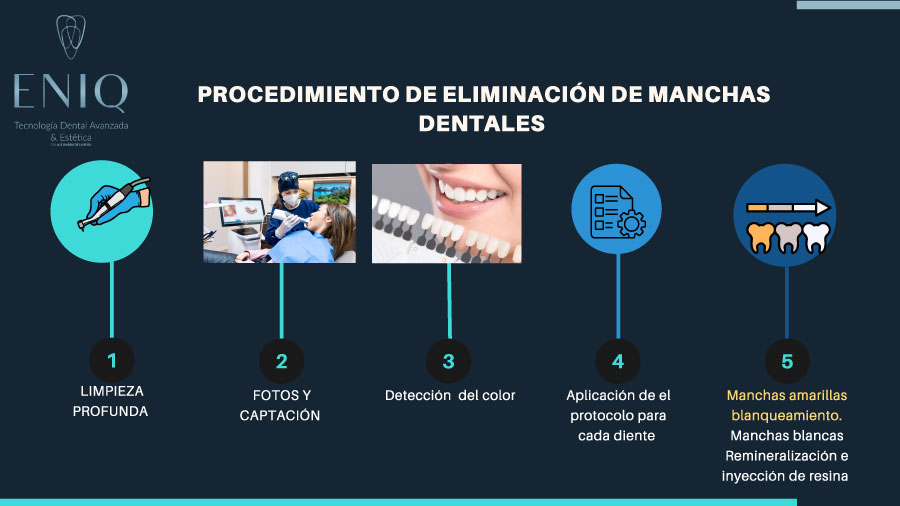

Common methods
Dental cleaning
Stain removal usually starts with a professional dental cleaning or prophylaxis. During this procedure, the dentist or dental hygienist uses special instruments, such as ultrasonic or hand scalers, to remove bacterial plaque, tartar and surface stains from the teeth. This improves the appearance of the teeth and helps prevent dental problems.
Teeth whitening
Teeth whitening is a procedure used to remove or reduce extrinsic stains on the teeth and improve their colour. It can be carried out at the dental clinic or with home whitening products under the dentist's supervision. Teeth whitening may involve chemical products, such as hydrogen peroxide, which help break down pigment molecules and lighten the tooth enamel.
Dental veneers
Dental veneers are thin layers of porcelain or composite resin bonded to the front surface of the teeth to improve their appearance. Veneers can be used to cover persistent intrinsic stains or stains that do not respond to teeth whitening. This procedure is more invasive, as it involves minimal reduction of the tooth enamel before the veneers are placed.
Dental restorations
In some cases, if the stains are the result of tooth decay or other dental conditions, dental restorations such as fillings or crowns may be needed to remove the stains and repair the damaged teeth.
It is important to note that the specific treatment for removing tooth stains will depend on the individual assessment of each patient and the dentist's recommendations. It is advisable to see a dental professional for an accurate diagnosis and to decide on the best approach to remove the stains.

What causes brown stains on teeth that are not cavities?
Brown stains on teeth that are not cavities can have various causes. Some possible explanations are:
- Food and drink stains: Frequent consumption of pigmented foods and drinks, such as coffee, tea, red wine, soy sauce or foods with artificial colourings, can cause brown stains on the teeth. These stains are extrinsic and are caused by pigments building up on the surface of the tooth enamel.
- Tobacco: Smoking cigarettes or chewing tobacco can cause brown stains on the teeth. The tar and chemical compounds in tobacco can stick to the tooth enamel and cause discolouration.
- Medication staining: Some medicines, such as tetracycline, taken while the teeth are developing can cause brown or grey stains on the teeth. These stains are intrinsic and form when the medicine is incorporated into the structure of the tooth as it develops.
- Dental trauma or injury: A blow or injury to a tooth can cause brown stains to appear. Trauma can damage the tooth pulp or cause internal bleeding, resulting in discolouration of the tooth.
- Fluorosis: Excess fluoride while the teeth are developing, whether from consuming too much fluoride or from exposure to high concentrations of fluoride in drinking water, can cause brown stains on the teeth. Fluorosis is a condition that affects the tooth enamel and can cause discolouration and changes in the appearance of the teeth.
Why do children get white spots on their teeth?
White spots on children's teeth can have various causes. Some possible explanations are:
- Enamel hypoplasia: Enamel hypoplasia is a condition in which the tooth enamel has not formed properly while the tooth was developing. It can appear as white, opaque or porous spots on the teeth. It can be caused by factors such as high fever in early childhood, nutritional deficiencies or certain illnesses.
- Early cavities: White spots can also be the result of demineralisation of the tooth enamel caused by decay. Decay begins with a loss of minerals in the enamel, which shows up as white spots before visible cavities form. These spots are an early sign of decay and should be treated to stop the disease from progressing.
- Excess fluoride: Consuming too much fluoride while the tooth enamel is forming can cause white spots or mottling on the teeth, a condition known as dental fluorosis. This can happen when children ingest too much fluoride through drinking water, toothpaste or other sources.
- Calcium stones (sialoliths): In some cases, white spots can be the result of calcium deposits in the salivary glands, known as sialoliths. These deposits can affect the flow of saliva and cause discolouration of nearby teeth.
How are white spots on the teeth treated?
The treatment of white spots on the teeth depends on the underlying cause and the extent of the spots. Some treatment options include:
- Remineralisation: If the white spots are the result of early enamel demineralisation, products containing fluoride or calcium can be applied to remineralise and strengthen the enamel. This can help restore the appearance of the tooth. At ENIQ we remove between 90% and 100% of white spots with our advanced remineralisation treatment.
- Microabrasion: This procedure removes a thin layer of tooth enamel using an acidic solution and an abrasive paste. Microabrasion can help reduce the appearance of superficial white spots.
- Dental veneers: In more severe cases, or when the white spots are persistent, dental veneers may be considered. Veneers are thin layers of porcelain or composite resin bonded to the front surface of the teeth to improve their appearance.
What are the benefits of treating tooth stains at ENIQ?
Treating tooth stains with advanced technology can offer several benefits compared with traditional methods:
Precision
Advanced technology allows precise, targeted control, directing the treatment exactly at the areas affected by the stains.
Faster results
Treatments with advanced technology can deliver visible results in less time than traditional methods.
Less discomfort
Technologically advanced procedures tend to be less invasive and more comfortable for the patient.
Personalisation
Technology makes it possible to tailor the treatment to each patient's specific needs to achieve the best results.
Significant aesthetic improvement
Advanced treatments can give the teeth a whiter, more even and natural appearance.
Tooth stain treatment prices
Tooth stains
Perfect smile
Personalised treatment to remove tooth stains and achieve a whiter, more even smile.
Personalised diagnosis

Frequently asked questions about tooth stains
Answers to your questions about tooth stain treatment in Madrid. customer service.
It depends on the type of stain. Surface stains caused by coffee, tea, red wine, tobacco or a build-up of plaque and tartar can usually be removed with a professional dental cleaning or teeth whitening. Persistent intrinsic stains, or stains that do not respond to whitening, can be covered with dental veneers. If the stain is caused by decay, it needs to be treated with a restoration, such as a filling or a crown. At the assessment we identify the type of stain and recommend the right treatment.
It depends on their cause and extent. If they are due to early enamel demineralisation, they are treated with remineralisation, applying products containing fluoride or calcium that strengthen the enamel. Superficial white spots can be reduced with microabrasion, which removes a thin layer of enamel using an acidic solution and an abrasive paste. In more severe or persistent cases, dental veneers may be considered. If the white spot is an early cavity, it needs to be treated to stop it from progressing.
It depends on the type of stain and the treatment it needs. As a guide, remineralisation costs between €50 and €350, and dental veneers start at €250 per tooth. If the stain is treated with whitening, the price depends on the method chosen. We confirm the exact price of your treatment, including microabrasion, at your assessment.
The most common causes are frequent consumption of pigmented foods and drinks, such as coffee, tea, red wine or soy sauce; tobacco; certain medicines, such as tetracycline, taken while the teeth are developing; a blow or injury to the tooth; and fluorosis, caused by excess fluoride while the teeth are forming.
Yes. Over time, teeth can become somewhat discoloured due to enamel wear and other factors. Good oral care habits can slow this process down.
Yes. Tobacco can cause brown stains on the teeth because of the chemical compounds it contains. Quitting smoking can help prevent and reduce these stains.
Completely removing tooth stains depends on their cause and severity. Some stains can be treated successfully, while others may require more intensive approaches to improve the appearance of the teeth.